A conventional damper exists to turn vertical motion into heat. Gravity's system turns the same motion into hydraulic pressure, then into electricity. No new physics is required. The work is engineering.
A loaded Class 8 tractor-trailer moves tens of thousands of kilograms over a road surface that is never flat. Every vertical displacement of the axle is kinetic energy the vehicle paid for in fuel. A damper converts it to heat and vents it to the air on every mile.
That energy scales with vehicle mass, speed, and road roughness. Heavier vehicles produce more harvestable energy per event, which is why heavy commercial platforms are the entry point and lighter vehicles follow as unit cost falls with volume.
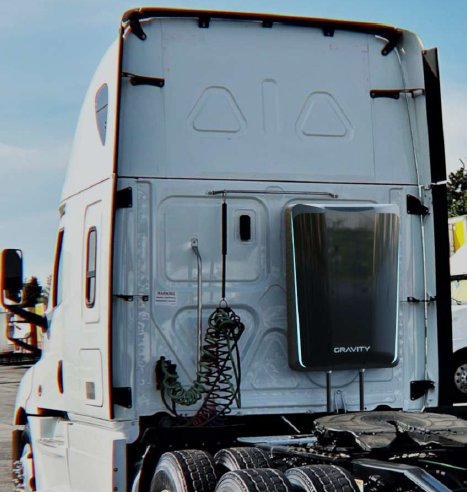
The system performs three functions in one pressurized volume: turbine power generation, fluid return, and suspension spring. It operates without driver intervention and within the manufacturer's suspension specification.
Wheel travel drives hydraulic positive-displacement pumps. Compression and rebound both do work.
Dual hydraulic accumulators smooth a pulsed, road-dependent input into a steady supply. This is what turns a noisy signal into continuous electrical output.
Pressurized fluid drives an impulse turbine coupled to a generator. Runner mass stores rotational energy between events.
Variable output passes through DC-DC conversion into a 48 V lithium iron phosphate pack with pack-level battery management. The chemistry is chosen for thermal stability and cycle life.
Surplus stored energy transfers to facility storage when the vehicle returns. The facility draws on it during peak-rate hours or grid outages.
Specific spring-medium and internal geometry details are protected and disclosed to engineering counterparties under non-disclosure agreement.
Gravity separates measured hardware results from engineering simulation and never presents one as the other.
| Figure | Status | Basis |
|---|---|---|
| 415 Wpeak electrical output | Measured | Instrumented closed-course testing on the trail prototype. Validates the complete conversion chain: suspension motion to hydraulic pressure to turbine to generator to battery. It is not a commercial output figure. |
| 32 kWgross hydraulic capture, Class 8 | Modeled | Pratt Miller Engineering simulation on Peterbilt 589 road-profile data. An engineering figure, before conversion losses. |
| 10 kWnet continuous electrical output, Class 8 | Modeled | After conversion losses. This is the commercial output figure used in all fleet and program planning. |
| 20,000 kWhper vehicle, per year | Modeled | 10 kW net over a 2,000-hour annual duty cycle. |
| Class 8 outputfull-scale hardware | Unmeasured | No full-scale Class 8 hardware test has been conducted. Closing the gap between the measured prototype and the modeled tractor is the current engineering program. |
The measured figure comes from a trail-vehicle prototype tested on an instrumented closed course. The modeled figures come from a Class 8 simulation built by Pratt Miller Engineering on Peterbilt 589 road-profile data. Closing the gap between them with a full-scale demonstrator on a real tractor is the current engineering program, and that demonstrator doubles as the platform fleet operators will evaluate.
Five issued United States patents, with protection in 19 countries across the United States, Canada, Australia, Japan, the United Kingdom, and fourteen European states. A sixth U.S. application is pending.
| Jurisdiction | Number | Issued |
|---|---|---|
| United States | 10,583,707 | March 10, 2020 |
| United States | 10,723,193 | July 28, 2020 |
| United States | 11,203,242 | December 21, 2021 |
| United States | 11,648,809 | May 16, 2023 |
| United States | 12,128,722 | October 29, 2024 |
| United States | Application 18/929,817 | Pending |
| Europe (validated in 15 states) | EP 3370985 | April 28, 2021 |
| Canada | 3,004,407 | May 19, 2020 |
| Japan | 6,625,234 | December 6, 2019 |
| Australia | 2016350551 | May 2, 2019 |
Manufacturers need to de-risk the factory-fit decision before committing engineering resources. Gravity's path runs retrofit first: instrumented units installed on the manufacturer's own platform generate the duty-cycle data that supports an integration program. Peterbilt Motors, a PACCAR company, has engaged under a three-party agreement and contributed the road-profile data behind the Class 8 model.
The commercial structure is licensing and royalty. Gravity holds the architecture and the patents; the manufacturer integrates and builds. The same trailing-arm architecture extends to gooseneck trailers and recreational tow-behind platforms under the same model.
Pratt Miller Engineering, a Tier-1 integrator with program history across motorsport, the U.S. Army, and DARPA, built the Class 8 simulation and has defined the engineering path to a production-ready system.
